

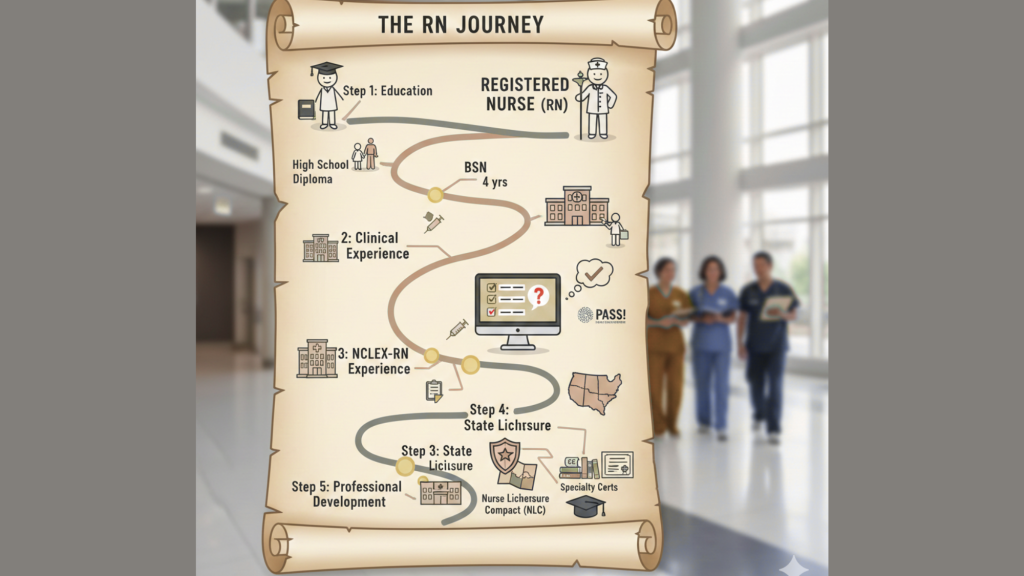
Becoming a Registered Nurse (RN) is a deeply rewarding career, offering the chance to make a profound difference in people’s lives every single day. The nursing profession demands critical thinking, compassion, and a dedication to lifelong learning. For students and learners interested in this vital field, understanding the clear steps involved is essential. This guide outlines the formal, educational, and licensing process required to join the ranks of professional RNs.
For those passionate about healthcare, Becoming a Registered Nurse is a noble pursuit that contributes significantly to society.
Step 1: Achieve the Necessary Education
Understanding the nuances of the profession is crucial for anyone Becoming a Registered Nurse.
The first and most critical step is earning a nursing degree from an accredited program. There are three primary educational pathways that qualify a candidate to sit for the national licensing exam:
- Associate Degree in Nursing (ADN): Typically offered at community colleges, this program usually takes two to three years to complete. It provides the foundational knowledge and clinical skills necessary for entry-level nursing practice.
- Bachelor of Science in Nursing (BSN): Offered at four-year universities, the BSN is generally considered the standard entry point for professional nursing practice. It takes approximately four years and includes a broader curriculum covering leadership, research, public health, and management, often leading to greater career mobility and higher earning potential.
- Diploma in Nursing: Historically common, this is now the least common route. These programs are hospital-based and typically last two to three years.
Choosing a program accredited by a recognized body, such as the Accreditation Commission for Education in Nursing (ACEN) or the Commission on Collegiate Nursing Education (CCNE), is non-negotiable, as graduation from an accredited program is mandatory to proceed with licensing.
Step 2: Gain Hands-On Clinical Experience
Formal education is always paired with clinical rotations. These supervised, hands-on experiences take place in real healthcare settings, such as hospitals, clinics, and long-term care facilities. Clinical experience is crucial for translating theoretical knowledge into practical skills. During this time, students learn to:
Hands-on practice is invaluable for Becoming a Registered Nurse and ensuring capable patient care.
- Administer medications safely.
- Perform physical assessments.
- Develop patient care plans.
- Master essential nursing procedures.
- Practice communication and teamwork within a healthcare team.
This experience is fundamental to developing the competency and confidence required of a professional nurse.
Step 3: Pass the NCLEX-RN Examination
Upon graduation from an accredited program, the next major hurdle is passing the National Council Licensure Examination for Registered Nurses (NCLEX-RN). This is a standardized, computer-adaptive test (CAT) administered by the National Council of State Boards of Nursing (NCSBN).
The NCLEX-RN is designed to assess whether a candidate possesses the minimum knowledge, skills, and abilities necessary for the safe and effective practice of nursing at the entry-level. The exam covers four major categories of client needs:
- Safe and Effective Care Environment
- Health Promotion and Maintenance
- Psychosocial Integrity
- Physiological Integrity
Preparation for the NCLEX-RN is crucial for those Becoming a Registered Nurse.
Step 4: Obtain State Licensure
The journey of Becoming a Registered Nurse culminates with the NCLEX-RN examination.
Once you have successfully passed the NCLEX-RN, you must apply for licensure through the Board of Nursing (BON) in the state or territory where you intend to practice. Nursing licensure is issued by the state, not the federal government.
The requirements for licensure generally include:
- Proof of graduation from an approved nursing program.
- A passing score on the NCLEX-RN.
- A criminal background check and fingerprinting.
It is important to note the existence of the Nurse Licensure Compact (NLC). If you are licensed in a state that is part of the NLC, you are able to practice in other NLC states without obtaining additional licenses, simplifying mobility.
Step 5: Pursue Continuous Professional Development on Becoming a Registered Nurse
Achieving RN status is the beginning, not the end, of your educational journey. Nursing is a field that constantly evolves due to new research, technology, and treatment protocols. Continuing education (CE) is mandatory in most states for license renewal.
As an RN, you can further your career by:
- Gaining experience in a specialty area (e.g., critical care, pediatrics, oncology).
- Earning advanced certifications (e.g., Certified Registered Nurse Infusion (CRNI) or Trauma Certified Registered Nurse (TCRN)).
- Pursuing advanced degrees, such as a Master of Science in Nursing (MSN) or a Doctor of Nursing Practice (DNP), to become a Nurse Practitioner, Nurse Educator, or Nurse Administrator.
Becoming a Registered Nurse requires commitment, diligence, and a passion for helping others. By successfully navigating these five steps, aspiring nurses can secure a respected, fulfilling, and essential role in the healthcare system.


Pingback: Ultimate RN Nurse Salary: 7 Powerful Factors Revealed