

Multiple-choice exams can be tricky. They test what you know and also how well you can navigate complex questions and tempting distractors. Success on these tests isn’t about luck; it’s about employing a consistent strategy both in how you study and how you approach the answer sheet.
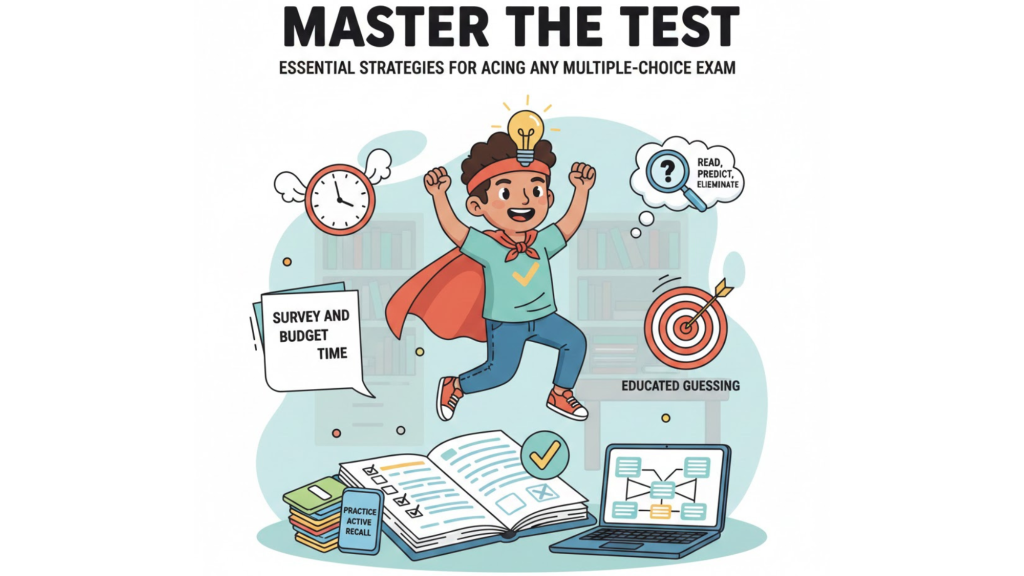
Winning Before You Walk In
Passing a multiple-choice exam starts long before the test begins. Effective studying involves active techniques tailored to the format, ensuring true understanding beyond simple memorization.
• Practice Active Recall Instead of just re-reading notes, dedicate time to active recall. A highly effective method is to create your own practice questions by turning textbook headings, subheadings, and key lecture concepts into multiple-choice items. This forces you to think like the instructor and identify potential distractors . Exchanging these self-generated quizzes with classmates creates a larger pool of challenging practice material .
• Study Broadly and Deeply Multiple-choice exams often cover a broad range of material . Focus on understanding the relationships between concepts, not just isolated facts. Use concept maps or diagrams to summarize and connect major topics. Space out your studying into shorter segments over many days, as frequent, targeted repetition is far better for retention than cramming.
Managing Time and Questions
The way you navigate the exam booklet can significantly impact your score. Use these techniques to maximize your time and mental clarity.
• Survey and Budget Time Before answering a single question, take a quick read-through of the entire exam to get an overview and check for completeness. Then, divide your total allotted time by the number of questions to determine a rough time limit per item, allowing a 10-minute buffer at the end for review.
• Read, Predict, Eliminate For each question, implement a three-step method:
- Cover the answers and read the question stem carefully, noting keywords like “NOT,” “ALWAYS,” or “UNLESS.”
- Predict the correct answer in your mind before viewing the options .
- Read all options and eliminate choices that are obviously incorrect. If your predicted answer is present, tentatively select it, but ensure you read the rest, especially if options like “All of the Above” or “A and B” are present . Always select the best answer among the choices.
The Art of Elimination – taking an educated guess.
When you encounter a difficult question, do not panic or leave it blank . Use process of elimination to increase your odds.
• Look for Absolute Language Be alert for absolute words like always, never, all, or none. Statements containing these words are often incorrect because they must be true without exception. Conversely, qualifying words like most, usually, seldom, or often tend to be found in correct answers .
• Trust Your Instincts If you are stuck between two final choices, make an educated guess, but mark the question and move on. Research suggests your first intuitive response, based on knowledge that may be difficult to consciously recall, is often correct. Only change an answer if you are absolutely certain you misread the question or discovered new information later in the test.

Pingback: Strategy On Passing Multiple Choice Questions. - Ask Proctor