

In the healthcare world,Licensed Practical Nurse (LPN) or a Registered Nurse (RN) both provide essential care but they differ significantly in education, responsibility, and salary.
Educational Requirements
The most immediate difference is the time spent in the classroom.
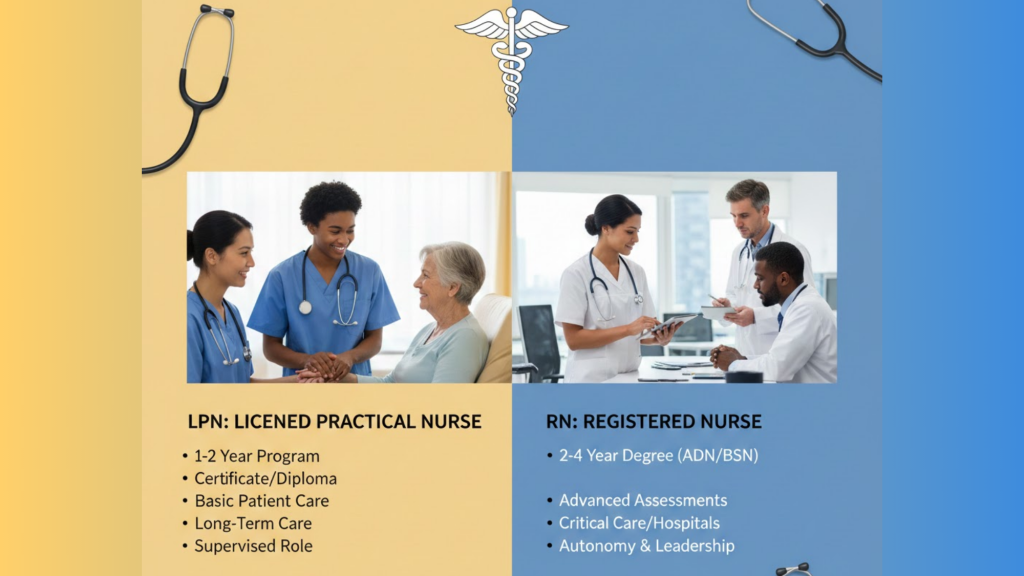
- LPNs:Programs typically take 12 to 18 months and result in a diploma or certificate. These programs focus heavily on practical, hands-on skills.
- RNs: Becoming an RN requires a degree. Students can choose an Associate Degree in Nursing (ADN), which takes about two years, or a Bachelor of Science in Nursing (BSN), which takes four years. RN education includes advanced clinical theory, leadership, and complex diagnostics.
Regardless of the path, both must pass a national licensure exam: the NCLEX-PN for LPNs and the NCLEX-RN for RNs.
Scope of Practice and Roles
The daily duties of these two roles reflect their level of training.
- LPN Role: LPNs provide basic nursing care. Their tasks include monitoring vital signs, assisting with activities of daily living , administering basic medications, and reporting patient status to the rest of the team. Crucially, LPNs must work under the supervision of an RN or a physician.
- RN Role: RNs have a broader scope of practice and greater autonomy. They perform complex assessments, develop patient care plans, and administer advanced treatments like IV medications. RNs are also trained to use critical thinking to analyze diagnostic tests and educate patients on long-term health management.
Work Environments
While both work in various settings, their presence varies by facility:
- LPNs are most commonly found in long-term care facilities, nursing homes, and home healthcare, where patient conditions are generally stable.
- RNs make up the majority of the staff in hospitals and specialized units , where patients require high-acuity care and constant assessment.
Salary and Career Growth
Because of the added responsibility and education, RNs earn significantly more than LPNs. RNs have more doors open for advancement. They can specialize in fields like pediatrics or oncology and move into management or leadership roles. LPNs who wish to advance often enroll in LPN-to-RN bridge programs to transition into these higher-level responsibilities.
Which Path is Right ?
It all depends on your goals. If you want to enter the workforce quickly with a lower financial investment, the LPN route is ideal. However, if you seek higher earning potential, autonomy, and leadership opportunities, pursuing an RN license is the better long-term investment. Both roles are vital, and both offer the rewarding opportunity to make a difference in patients’ lives every day.