

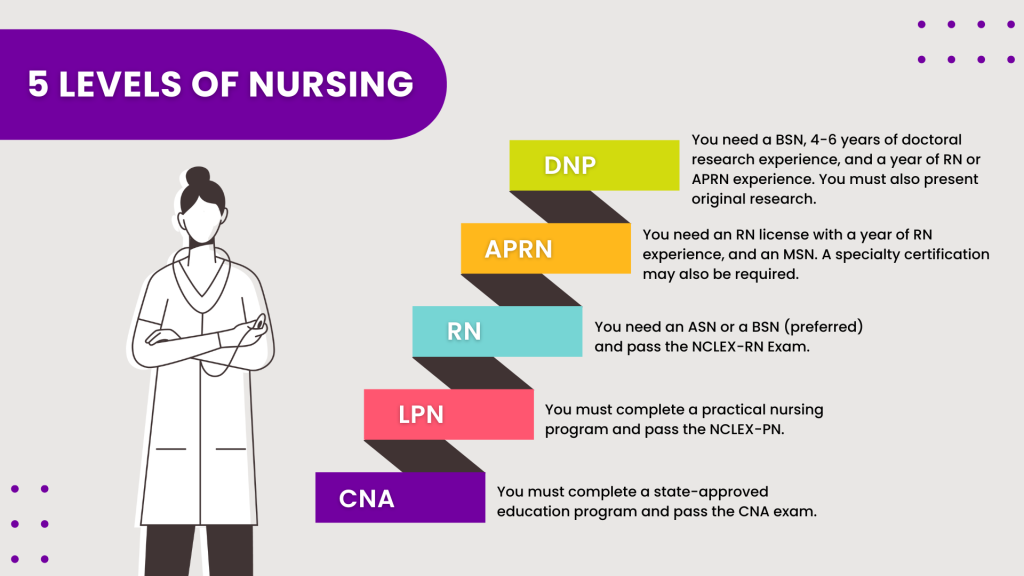
The five levels of nursing represent a structured career ladder that begins with entry-level support roles and culminates in advanced clinical or leadership positions. These levels reflect increasing responsibilities, education requirements, licensure, and autonomy in patient care.
1. Certified Nursing Assistant (CNA)
- Role: CNAs provide basic patient care under the supervision of licensed nurses.
- Duties: Assist with activities of daily living (bathing, dressing, eating), take vital signs, and relay patient concerns to nursing staff.
- Education: 4–12 weeks of state-approved training.
- Licensure: Must pass a competency exam to receive state certification.
- Note: CNAs are not licensed nurses but serve as essential frontline caregivers, especially in long-term care settings.
2. Licensed Practical Nurse (LPN) / Licensed Vocational Nurse (LVN)
- Role: LPNs deliver foundational nursing care under the supervision of RNs or physicians.
- Duties: Administer medications (state-dependent), monitor patient health, insert catheters, change dressings, and document care.
- Education: 12–18 months of practical nursing program (diploma or certificate).
- Licensure: Must pass the NCLEX-PN exam.
- Note: In California and Texas, LPNs are called LVNs. LPNs may supervise CNAs but require oversight for complex tasks.
3. Registered Nurse (RN)
- Role: RNs coordinate and deliver comprehensive patient care across diverse settings.
- Duties: Assess patients, develop care plans, administer treatments, educate patients, and supervise CNAs and LPNs.
- Education: Choose between:
- Associate Degree in Nursing (ADN): 2 years
- Bachelor of Science in Nursing (BSN): 4 years (increasingly preferred by employers)
- Licensure: Must pass the NCLEX-RN exam and obtain state licensure.
- Note: RNs can specialize in areas like emergency care, pediatrics, or mental health and often pursue BSN completion via RN-to-BSN programs.
4. Advanced Practice Registered Nurse (APRN)
- Role: APRNs provide advanced, often independent, patient care and may serve as primary healthcare providers.
- Specialties include:
- Nurse Practitioner (NP)
- Certified Registered Nurse Anesthetist (CRNA)
- Clinical Nurse Specialist (CNS)
- Certified Nurse-Midwife (CNM)
- Education: Master of Science in Nursing (MSN) or Doctor of Nursing Practice (DNP); CRNAs must hold a DNP by 2025.
- Licensure: Requires RN licensure, clinical experience, graduate degree, and national certification in specialty.
- Autonomy: Varies by state, many APRNs have full practice authority to diagnose, treat, and prescribe.
5. Nursing Leadership / Non-Clinical Advanced Roles
- Role: These professionals shape healthcare systems through administration, education, policy, or research: often with minimal direct patient care.
- Common Titles:
- Nurse Manager / Director of Nursing
- Nurse Educator
- Chief Nursing Officer (CNO)
- Healthcare Administrator
- Education: MSN, DNP, or PhD in Nursing (for research-focused roles).
- Focus Areas: Organizational leadership, curriculum development, informatics, public health, or healthcare policy.
- Impact: Influence system-wide improvements, staff development, and patient outcomes at institutional or national levels.
These five levels shows a clear pathway for career advancement in nursing. Each step requires additional education, clinical experience, and licensure, but also offers greater responsibility, autonomy, and earning potential.
Whether focused on bedside care or system-level change, nurses at every level play a vital role in delivering high-quality healthcare.